This article covers an annual event. Dates, venues and traffic rules change from one edition to the next: it is reviewed every year, and the official websites prevail.
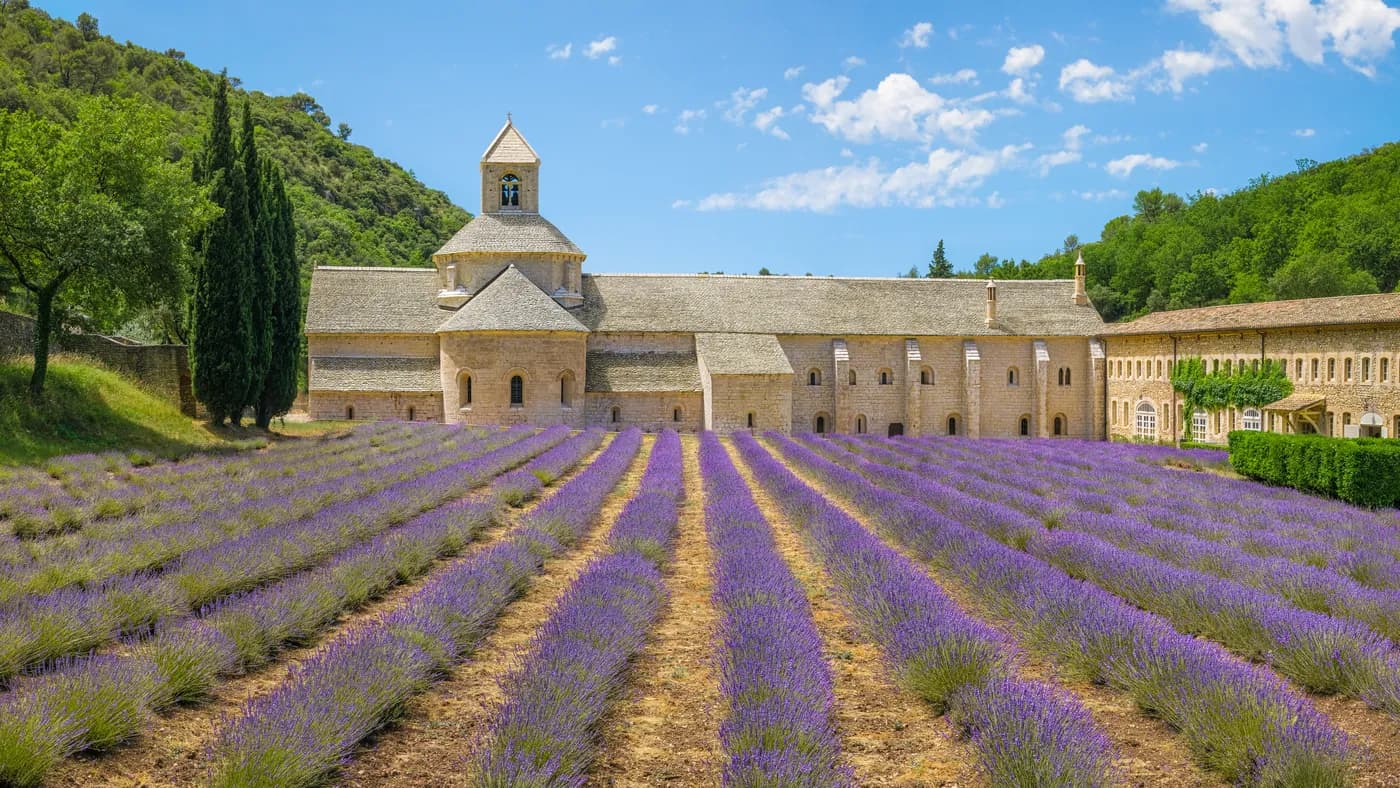
Opening photo: Notre-Dame de Sénanque Abbey, near Gordes, and its lavender, harvested in July.
Two festivals born after the war
The Avignon Festival was founded in 1947 by Jean Vilar, and the Cour d’honneur of the Palais des Papes is its birthplace. The Aix Festival came to life in the summer of 1948, around Gabriel Dussurget and a team of enthusiasts.
In Aix, the courtyard of the former archbishop’s palace, which became a public garden in the 20th century, established itself from 1948 as the main venue for musical evenings; inspired by a visit to Salzburg, the project then set out to be a festival devoted to Mozart.
The Avignon Festival now uses more than thirty venues in the city and its region: gymnasiums, cloisters, chapels, gardens, quarries, churches. It describes itself as a cultural utopia that has repeated and reinvented itself since 1947, and now ranks among the major international events in contemporary performing arts.
Two cities, two arts, one month: you can choose, or treat yourself to both.
The Aix Festival: opera in the open air and indoors
The Aix Festival held its 78th edition from 2 to 21 July 2026: five opera productions, including one new work, two operas in concert version and sixteen concerts, to nearly 64,000 spectators. It has announced the next one from 1 to 20 July 2027.
Its venues are divided between the old town, with the open-air Théâtre de l’Archevêché and the Théâtre du Jeu de Paume, a former municipal theatre, and the Grand Théâtre de Provence, designed by the architect Vittorio Gregotti and completed in 2007, joined by the Darius-Milhaud conservatory. Over the years, other venues have hosted the Festival, such as the Domaine du Grand Saint-Jean.
Tickets are booked directly with the Festival, which points out that no booking can be made by email.
An evening at the opera can end late. So the time of the return is what to think about before anything else: where you will be met, and which way to reach your hotel or your country house.
The Avignon Festival and the Off
In 2026, the Avignon Festival held its 80th edition, from 4 to 25 July, and the Off festival took place on the same dates. At the time of writing, the dates for July 2027 have not yet been published: they will appear on the Festival’s website. The Festival also has a winter event: Fest’hiver is announced for 29, 30 and 31 January 2027, at La FabricA.
The Festival spills beyond the ramparts. Across the Rhône, in Villeneuve-lès-Avignon, the Chartreuse, the national centre for performance writing, opens to the public for open rehearsals or events, notably in July with the Festival.
In the evening, performances fill the cloisters, chapels and gardens; by day, the city is lived on foot, from one venue to the next.
Getting around Avignon during the Festival
During the 2026 Festival, the City of Avignon introduced, from 4 to 25 July and from noon to 2 am, a pedestrianisation plan with regulated access inside the walls, set by municipal order. Each year the City mobilises its services to welcome several hundred thousand visitors and festival-goers, and the increased crowds in the historic centre are what justify these measures.
During those hours, vehicles entered the ramparts through four gates: Thiers, Saint-Michel, République and Saint-Dominique. Apart from police and emergency services, access was reserved for residents and users registered with the City’s pedestrian zone control centre. The Rue de la République was closed to traffic from 11 am. New in 2026, the Porte de la Ligne opened from 2 am to noon to vehicles coming from the Pont Saint-Bénézet towards Saint-Lazare, to ease access to the north of the city in the morning. The bollards were fitted with intercoms linked to the control centre.
For other visitors, park-and-ride car parks, including those at Île Piot and Les Italiens, were linked to the centre by free shuttles, and several bus lines ran until 1 am. The City announced more than 4,400 parking spaces, and motorbikes had reserved areas near the Saint-Dominique, Thiers, Rocher and République gates.
These rules are set each year by municipal order: those of the current year are the ones that count. With a chauffeur, you are dropped off at a gate in the ramparts, as close as possible to the venue, and agree on a pick-up point outside the closed perimeter.
The heat, the hills and the lavender
July falls in the heart of the fire-risk season: from 1 June to 30 September, access to the forest areas of the Bouches-du-Rhône is regulated, with information published at around 6 pm for the next day. A walk in the hills is therefore checked the evening before.
Near Gordes, at Notre-Dame de Sénanque Abbey, the lavender spikes are fully formed by the end of June; the monks harvest it between 15 and 20 July. To see it in bloom, it is wiser to come before mid-July.
By day, you visit early, when the light is soft; the evening belongs to the performances. In between, the shade of a terrace does very nicely.
Preparing your July evenings
Book your seats with each festival before anything else. Transport is then built around the times: departure from the hotel, drop-off near the venue, pick-up point, dinner after the performance if you wish. The simplest is to give, for each evening, the venue and the start and end times announced by the festival: the rest follows. Several evenings, in Aix as in Avignon, can be included in a single request.
For an evening in Avignon leaving from Marseille or Aix, allow some leeway on the way there: the historic centre is then much busier, and that is what led the City to reserve it for pedestrians from noon into the night.
And if both festivals tempt you, alternate: an evening of opera in Aix, a day of theatre in Avignon, a day of rest in between, in a farmhouse or by the sea. July in Provence is to be savoured without haste.
This article is reviewed every year. Dates, venues and traffic rules change from one edition to the next; if in doubt, the official websites cited below prevail.
For your festival evenings and the drives around them: Events and trade fairs